Decide what is worth doing
Identify the business or public-service problem, test feasibility, understand risk and choose whether to build, buy, integrate, defer or stop.
IMPLEMENTATION + ASSURANCE
Digital Dance Artificial Intelligence (DDAI) helps public bodies, enterprises and artificial-intelligence suppliers choose, procure, build and operate systems with clear human accountability and evidence that can withstand review.
One bounded problem One accountable owner One acceptance boundary One evidence baseline
TECHNICAL DELIVERY
THE CUSTOMER PROBLEM
A prototype can show that a model is capable. It does not show that the workflow is worth operating, that the right people remain accountable, that data and permissions are controlled, or that a buyer or assurance team will accept the evidence.
DDAI helps organisations close that gap before artificial intelligence becomes an operational, procurement or governance problem.
WHAT DDAI DOES
Identify the business or public-service problem, test feasibility, understand risk and choose whether to build, buy, integrate, defer or stop.
Define the intended purpose, data and system boundary, model and supplier dependencies, human accountability, evaluation criteria and failure routes.
Build, integrate or assess the workflow against written acceptance criteria rather than treating a demonstration as production proof.
Create the system record, decisions, approvals, evaluations, training and handover material needed for review and future change.
SERVICES
PUBLIC-SECTOR DELIVERY
DDAI supports public bodies and suppliers across England, Scotland, Wales, Northern Ireland and relevant European procurement markets.
We can help define the use case, procurement evidence, evaluation criteria, human-oversight requirements, controlled pilot, operational handover and first evidence baseline.
HOW AN ENGAGEMENT WORKS
Agree the system, intended purpose, buyer or service trigger, accountable owner, reviewers, exclusions and delivery boundary.
Map the workflow, data, suppliers, permissions, risks, acceptance criteria, human oversight and evidence requirements.
Run the sprint, assessment, training or implementation work inside the agreed boundary.
Record decisions, approvals, evaluations, gaps, remediation and handover material.
Make an explicit decision to deploy, remediate, procure, reject, expand or move into a recurring Evidary workflow.
ONE COMPANY · TWO COMMERCIAL MOTIONS
DDAI identifies and delivers the use case, operating controls, training and first evidence baseline.
Evidary maintains the resulting AI Evidence Passport, approvals, signed versions, verification, monitoring and reassessment where recurring software is appropriate.
Evidary is not mandatory for every consultancy engagement. DDAI work is designed so the evidence can move into Evidary without being reconstructed when the customer needs a living, reviewable record.
See how DDAI and Evidary work together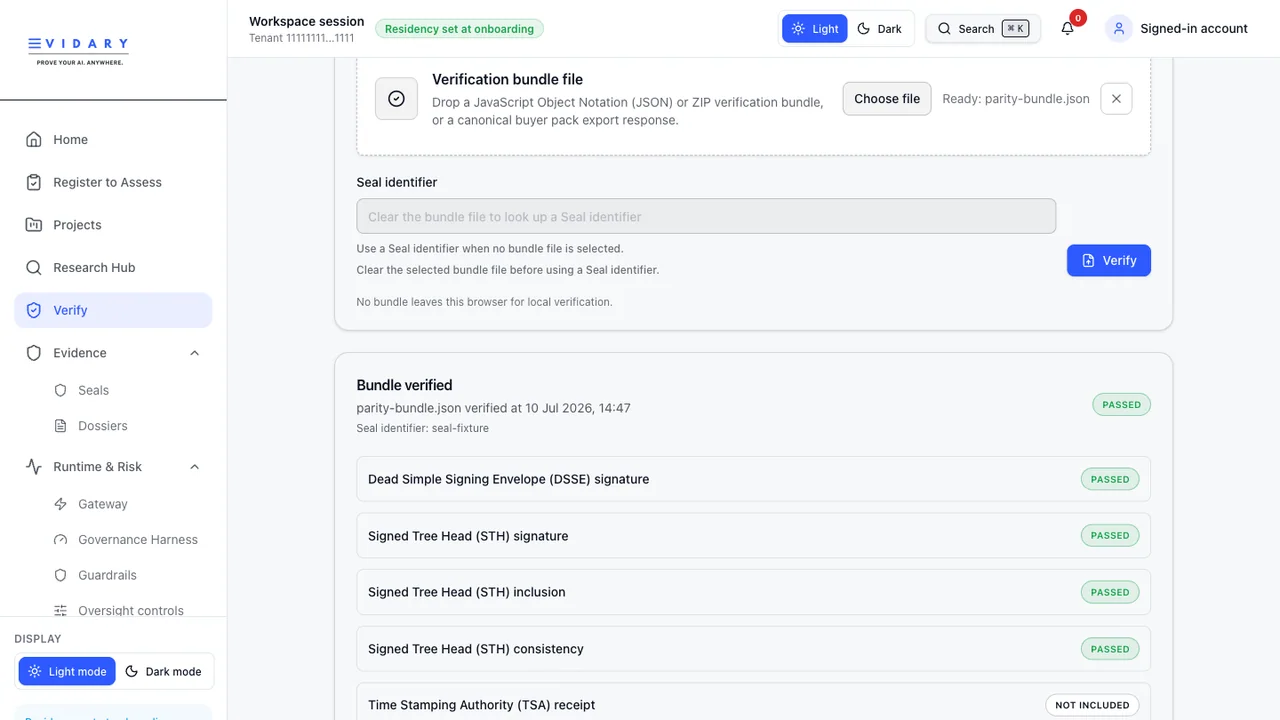
A buyer, reviewer, or assurance team can inspect the signature and supported proof material, see what was checked, and understand what remains missing or outside scope.
WHO WE WORK WITH
Teams procuring, piloting or operating artificial intelligence in public services.
Companies selling into enterprise, regulated or government buyers.
Teams facing board, audit, customer, sector or legal scrutiny.
Firms that need a repeatable evidence method while retaining professional judgement.
Organisations with a bounded, high-value workflow or a live buyer evidence request.
DDAI provides implementation, assessment, training and assurance support within an agreed scope. Legal classification, certification, conformity assessment and regulatory decisions remain with the appropriate professionals and authorities.
Start with one system, one buyer or service trigger and one accountable owner.